Here is a much delayed July Book Club Summary.
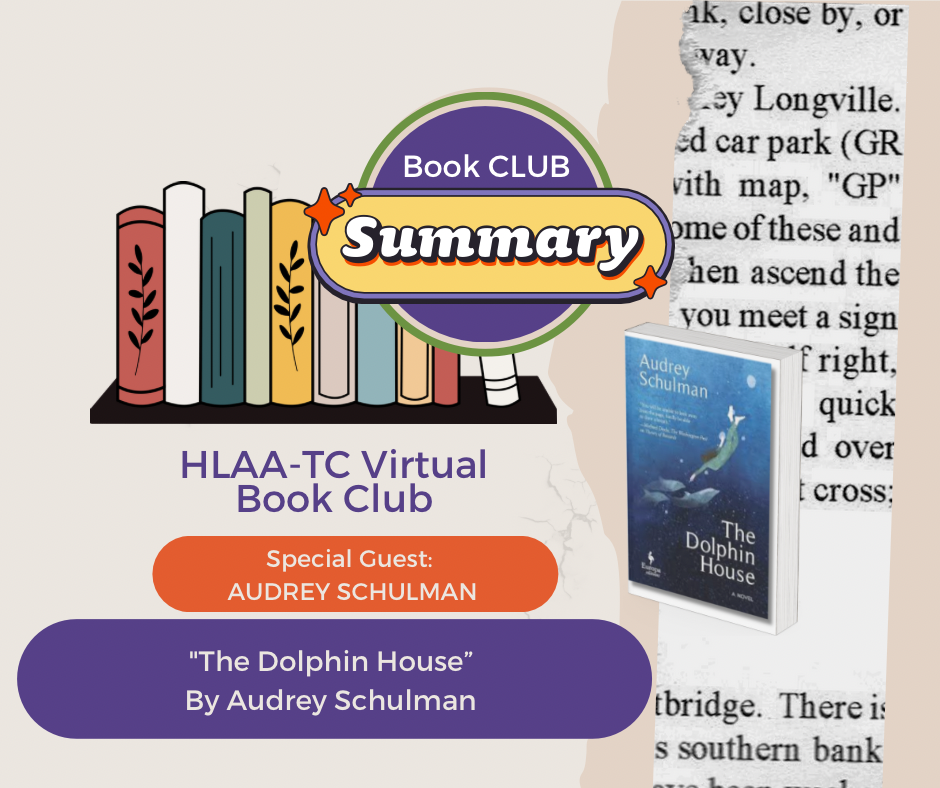
Thank you to those who joined us last week for our discussion of the novel “The Dolphin House” with our guest author Audrey Schulman. Below are links and points of interest from our discussion.
Next book club is:
Tuesday, August 27, 7:00 pm (Central Time), “Reflections of a Different Journey: What Adults With Disabilities Wish All Parents Knew.” Zoom Registration Link: https://us06web.zoom.us/meeting/register/tZwscO6uqT8jEtR388rjswgwMwQ7Q6nt_bB9 (No author attending).
Items of interest from our discussion of “The Dolphin House”:
*Note: This book was a work of fiction inspired by an actual experiment that happened in 1965. The characters in the book are fictional (the protagonist Cora has hearing loss when the woman she is based off of (Margaret Howe) doesn’t. Schulman added the hearing loss as means to make her character different. Schulman doesn’t have hearing loss herself and therefore did research on it (see resources listed below). *
(The following information is from the author’s acknowledgement section of the book, I have added links I have found):
-
- The first researchers to publish that dolphins can recognize themselves in mirrors are Diana Reiss and Lori Marino in 2001: A Blog with video about this
- Dr. Denise Herzing has a TED talk called “Could We Speak the Language of Dolphins?” She has a foundation, the Wild Dolphin Project, that funds this research. Watch the Ted Talk here.
- The Girl Who Talked to Dolphins, BBC: (link to clips)
- Information on John C. Lilly (available at libraries):
- Jeffrey, Francis; Lilly, John C. (1990). John Lilly, so far– (1st ed.).
- Lilly, John C. (1961). Man and Dolphin: Adventures of a New Scientific Frontier(1st ed.).
- Lilly, John C. (1978). Communication between Man and Dolphin: The Possibilities of Talking with Other Species.
- Lilly, John C. (1975). Lilly on Dolphins: Humans of the Sea.
- “Between Species: Celebrating the Dolphin-Human Bond.” Frohoff, Toni, and Brenda Peterson (editors) 2003. (Available at various outlets, including: Abe Books.)
- “Dolphin Diaries: My 25 Years with Spotted Dolphins in the Bahamas.” Herzing, Denise, L. (2011).(Available at various outlets, including: Abe Books.)
- “Dolphin Communication and Cognition.” Herzing, Denise, L. & Christine Johnson, editors. (Available at various outlets, including: alibris.com).
- “Voices in the Ocean: A Journey Into The Wild And Haunting World of Dolphins.” Casey, Susan (2016).(Available various outlets, including: Amazon).
- “The Diary of Abraham Ulrikab.” Hartmut Lutz, head translator and editor (2005). (Available at various outlets, including: Amazon).
- “Sound: A Memoir of Hearing Lost and Found.” Bathus, Bella (2018). (Available at various outlets, including: Amazon).
- “Mean Little Deaf Queer: A Memoir.” Galloway, Terry (2009).(Available at various outlets, including: Amazon).
- “Dark Pines.” Dean, Will (2018).(Available at various outlets, including: Amazon).
Other things we discussed:
-
- Sound waves in water: “Sound moves at a faster speed in water (1500 meters/sec) than in air (about 340 meters/sec) because the mechanical properties of water differ from air. Temperature also affects the speed of sound (e.g. sound travels faster in warm water than in cold water) and is very influential in some parts of the ocean.” From: Ocean Explorer, from the National Oceanic and Atmospheric Administration (NOAA)
- Hearing voices in water: “Audio pareidolia is a weird but common experience that happens when you perceive words from a random noise. The trigger for the phenomenon varies from person to person. For some, it’s their fan or running water.” From: Popular Science
- Hearing glasses in the 1960s: “Concealed Hearing Devices of the 20th Century.” From: Washington University School of Medicine, Bernard Becker Medical Library
- Audrey Schulman’s website: Audrey Schulman – Writer
- Audrey Schulman’s other books:
- A Theory of Bastards (2018)
- Three Weeks in December (2012)
- The Cage (1994)
- Swimming with Jonah (2000)
- A House Named Brazil (2000)